
Trading Rule #10 – Putting The Pieces Together – Part 2
If you didn’t read Rule # 9 yet – do so now or little of this will make sense.
At this point, you should be at the point where you appreciate that you need to get to know the market you are trading, like an old friend. That includes what triggers moves there.
Most people call these triggers “setups”, we call them “events”. Simply because people associate setups with charts. Yet charts are just one source of events.
On a low news day, an event might be “we reached the edge of a trading range”. If you trade Crude, you should know that US Crude Oil Inventories are announced on a Wednesday (https://tradingeconomics.com/united-states/crude-oil-stocks-change) – and this event ABSOLUTELY moves Crude.
Knowing the event is one thing. Taking advantage of it is a different matter entirely.
Free Training
Take a look into the decision making process of professional traders with this video training series that helps you make smarter trading decisions.
Let’s consider a very simple trade – a double top – when a market goes back to the high of the day and reverses.
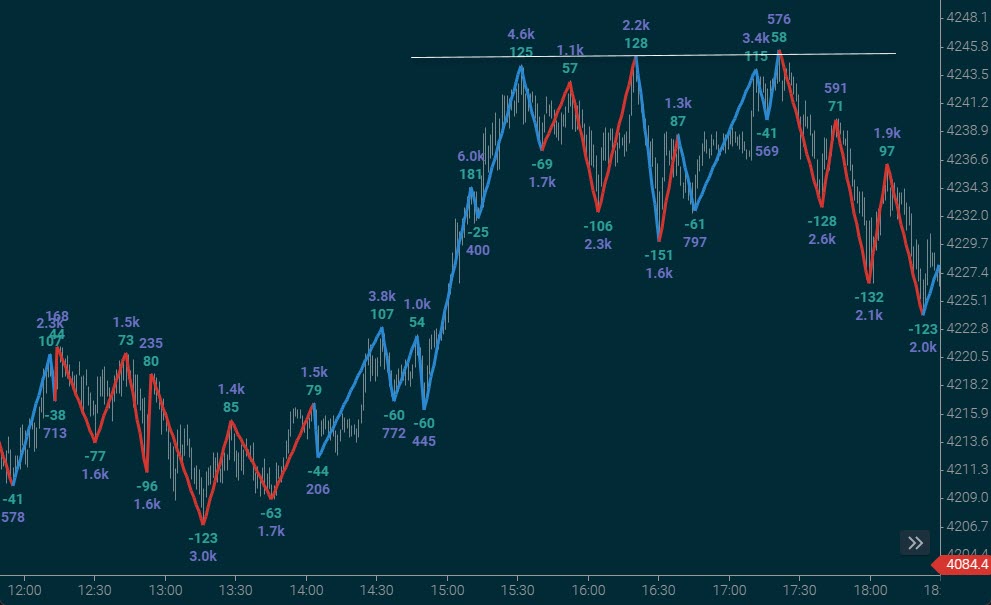
Very simple – in hindsight. But at the moment it occurs, this is what you’ll see:
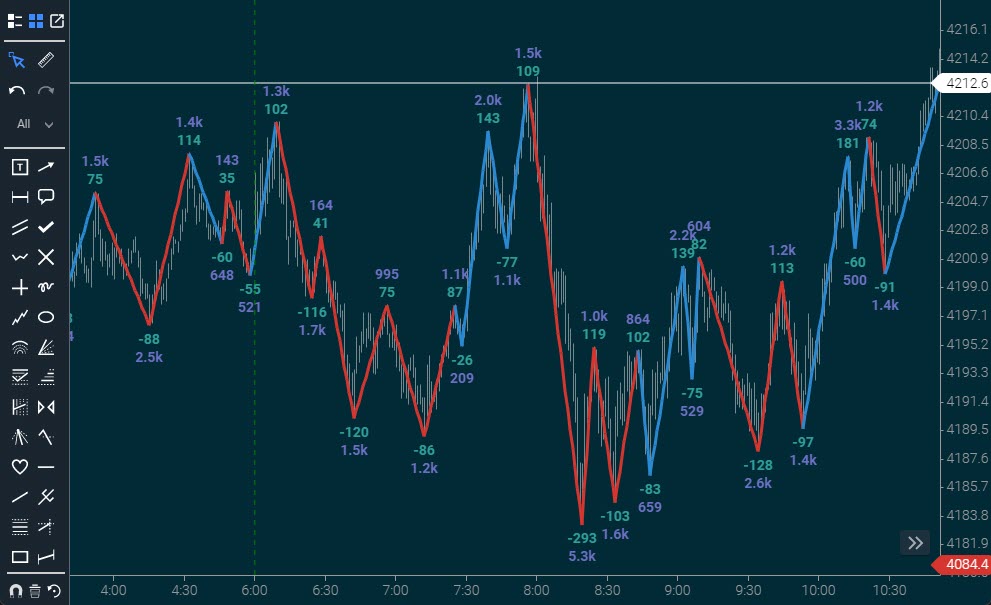
And this is how it played out:
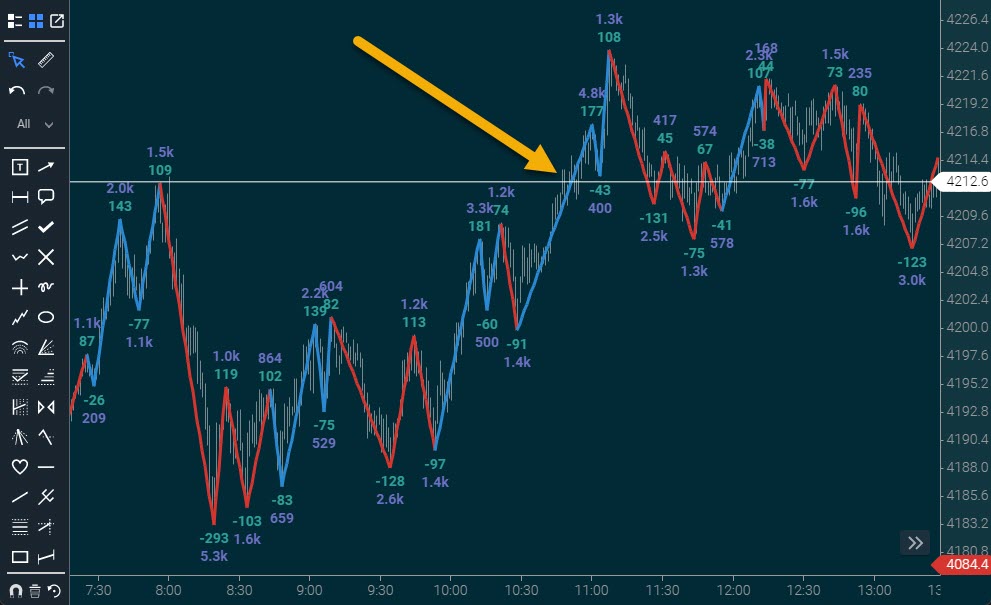
Knowing what might make a market move is not enough to trade it. You need a way to confirm that this time, it is indeed reversing. And with a double top, it can do one of these things:
- Reverse just before the old high.
- Reverse at the old high.
- Reverse just after the old high.
- Simply carry on.
You need to figure out which of these you’ll trade and the ideal goal is to trade 1,2 & 3 and not 4. You will not be right all the time, so if you can qualify/confirm your trade idea then you’ll make more money from it. Confirming a trade can mean many things
- Are correlated/inverse correlated markets doing what you expect? More on that here – https://www.jigsawtrading.com/blog/idiots-guide-to-market-relationships/
- Is the order flow confirming the trade (don’t buy against huge sell momentum)?
- Has the market (and correlated markets) acted as expected after you get in or should you cut the trade.
- Is there an iceberg being executed supporting your trade?
- Is cumulative delta on your side (tbh – since COVID, this is less reliable)
- Is volume increasing in moves on your side?
- Are large traders coming in on your side and moving your way?
At Jigsaw, we advocate heavily using Order Flow and swing charts for confirmation. The idea behind that is you’ll see certain changes in trader participation there first, well before the chart shows it.
Let me walk you through the options to trade this chart from my perspective.
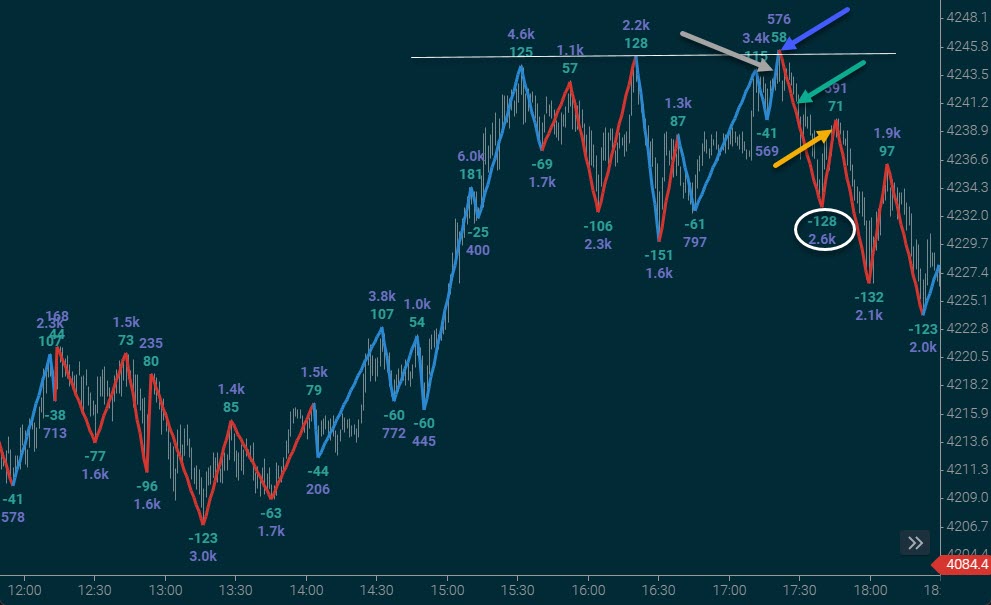
- Grey Arrow – Getting in as it approaches the top, in case it falls short, a risky approach with no confirmation unless you spot a slow down of trade as it approaches the top.
- Blue Arrow – At the top, in which case you will definitely miss any that reverse a little before the top.
- Green Arrow – Let it reverse, let the market show its hand and then get in.
- Orange Arrow – Let the market pullback after the market has shown its hand and then get in.
A lot of the time, confirmation is something you generally pay for with a poorer entry price. The more certainty you desire, the poorer the entry price and the higher the chance of a successful trade.
The white circle shows 2 numbers:
- Green – number of ticks (prices) in this move.
- Purple – number of contracts traded in this move.
The reason that’s significant is that when a market reverses, it almost always starts with a relatively large swing and with high volume (compared with recent swings).
This might seem like information you get really late but here’s the key:
An event (technical, fundamental, news) triggers a move. You can use the event to enter the market (Grey/Blue) arrows, or you can use it to set your bias. For me personally, something like a double top is ABSOLUTELY a great way to set a bias but a poor place to enter.
On S&P500, a double top often occurs when you re-visit overnight high during the day session. I would never be comfortable trading a double top (or support & resistance), but I’d be fine to say “now I need to trade in that direction”.
The mistake a lot of traders make when discovering events, is that they think they need to enter there and then.
In fact, I once heard one educator say:
- The “high of day” is a “wholesale price”.
- That’s where professionals get in.
- Everyone that gets in after that is a retail chump.
But:
- Retail chumps don’t perpetuate a move – size does.
- Pull up Time & Sales after a reversal from the old high and you’ll see large size trades all the way down.
- Most people at home are NOT throwing 50 lot trades at the market.
- Therefore – Professional/Institutional traders ARE keeping the move going.
- Maybe some DID get in early, but they’re still in, and they need the move to continue just as much as you do.
- You are not a putz or a patsy if you join them.
However you approach this, whether you get in early or late, I’d advise 2 things:
- You use Order Flow for final confirmation
- You spend time observing the event before you trade it to figure out your plan of attack
Even if a legit mentor gives you a trading framework, you cannot just take that advice and trade it.
This is not about them trading the move, it’s about YOU doing it. If your mentor is legit, he’ll have done it many times vs your zero.
You have to make it yours. The reps are what make it yours. Nobody said it better than Bruce:
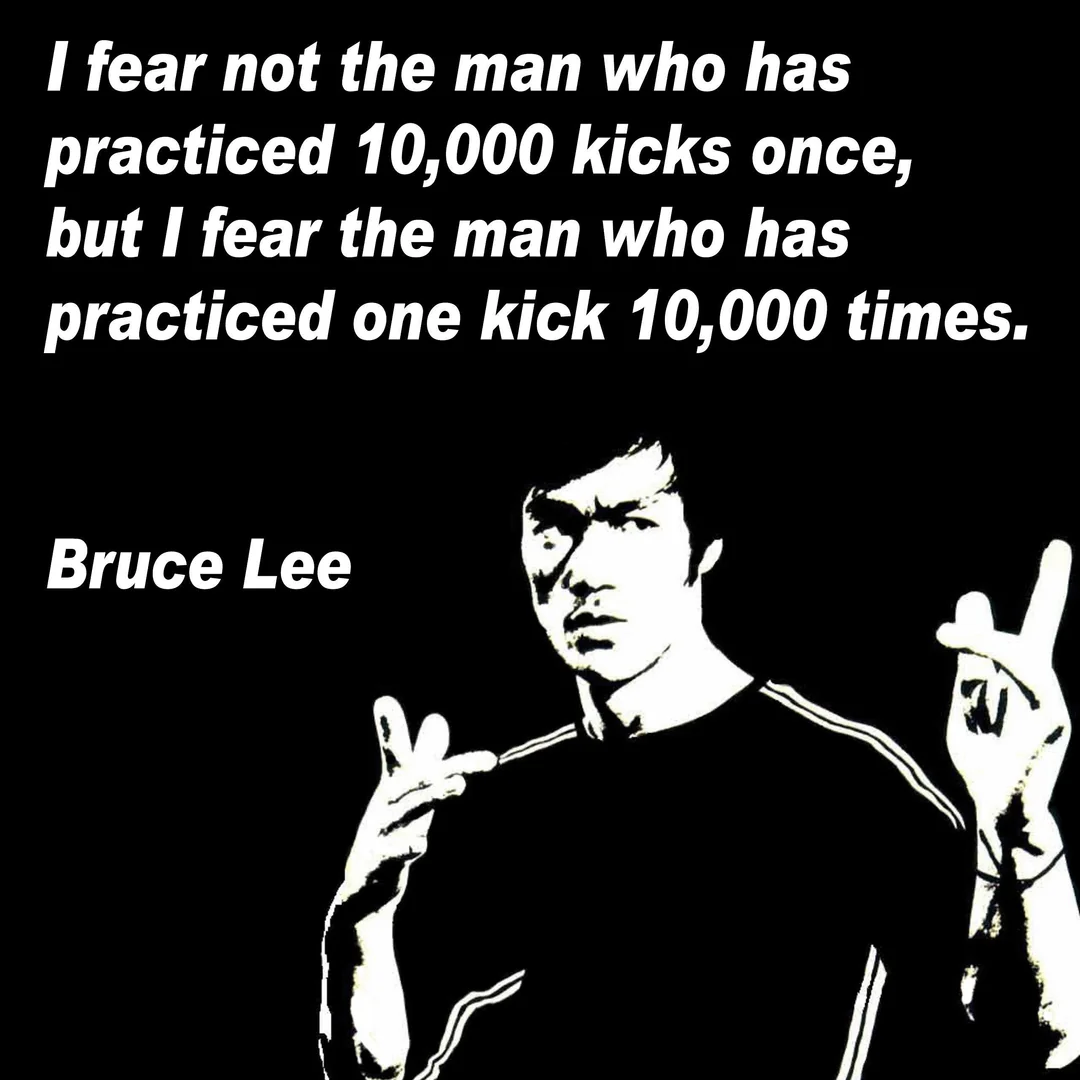
As you practise your “kick”, you might find you don’t spot the event at the same time as your mentor – that’s fine.
In this video Become a Better Trader in 2 Weeks – we discuss a process of observation to figure out when YOU will see the event which puts you on the path to being able to take advantage of it.
We’ll talk exits later but know this:
Whatever the opportunity is – you won’t catch that much of it at first.
Over time, you’ll get better and better at “squeezing more juice” out of a move. That also means, you’ll be a bit crap at it initially. Don’t be disheartened and move to another setup, you need the reps like Bruce says.
In summary:
- An event is something that makes a market move,
- It doesn’t matter what it is (but I’d avoid horoscopes and trading based on the color of Jim Cramer’s tie).
- You can approach that event in many ways but normally, the more confirmation you need, the later you’ll get in,
And that’s just fine!
Week’s goal: Pick one event from Rule 9. Watch it play out 10 times without trading it. Note where you’d have got in, and how much of the move you’d have caught.
Reward: Treat yourself to a meal and a drink. You just learnt how to bite chunks out of the market, so go bite a chunk of something tastier than a price chart.