
Trading Rule #18 – Sensible Use of Volume Profile
Let’s move on to something that’s key to using volume profile. Before we start, I want to suggest that from this point forward, whenever you read or watch anything on trading, I want you to ask yourself this question.
Has the reason “Why?” been explained.
For example, if someone tells you to enter the market when 2 lines cross, you need to ask why. Specifically “Why would other traders enter after me, if I get in at this point”. If there is no answer to that, it’s nonsense.
A good example is in Volume Profiles – anything that shows you how many trades took place at each price. That could be trades for the past few mins, the day, the week, a year.
Imagine every trade for the past year put into a profile like this:
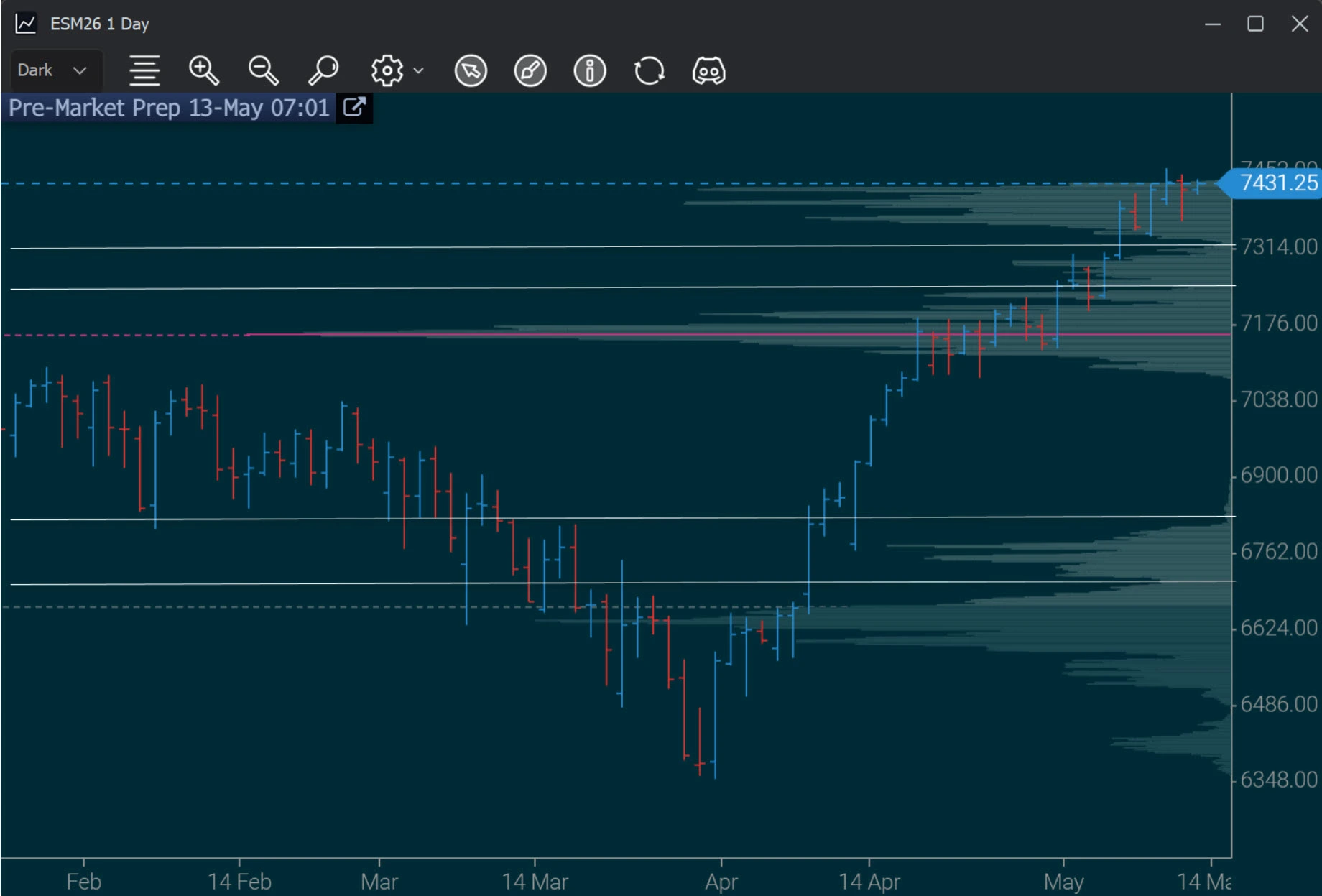
The theory is, that the prices we traded a small amount of volume will be potential turning points. I marked a few “Low Volume Nodes” with white lines there which VP acolytes would say is where value was rejected and will be again.
The “Why” – there isn’t a coherent one I’ve heard. The “white lie” used by educators in the 2010s was “the market has memory”.
Nobody actually had a coherent answer to it, this was the full description with no other explanation of how this “memory worked” – but boy – it sold a lot of courses.
I’m a market participant and so are you. Can you remember all of yesterday’s trades? How about last week’s?
How many times have you had a tingly feeling in your belly thinking “Ah yes, 7340.25. I remember emotionally bonding with that price last Easter.”
Never, right?
Neither has anyone else. Imagine if we’d charted the price and sale of bananas at the supermarket – of course, you will have a price you won’t pay above and a price you can’t resist. But between those prices, do you mysteriously feel inclined to buy bananas because we go down to a low volume node?
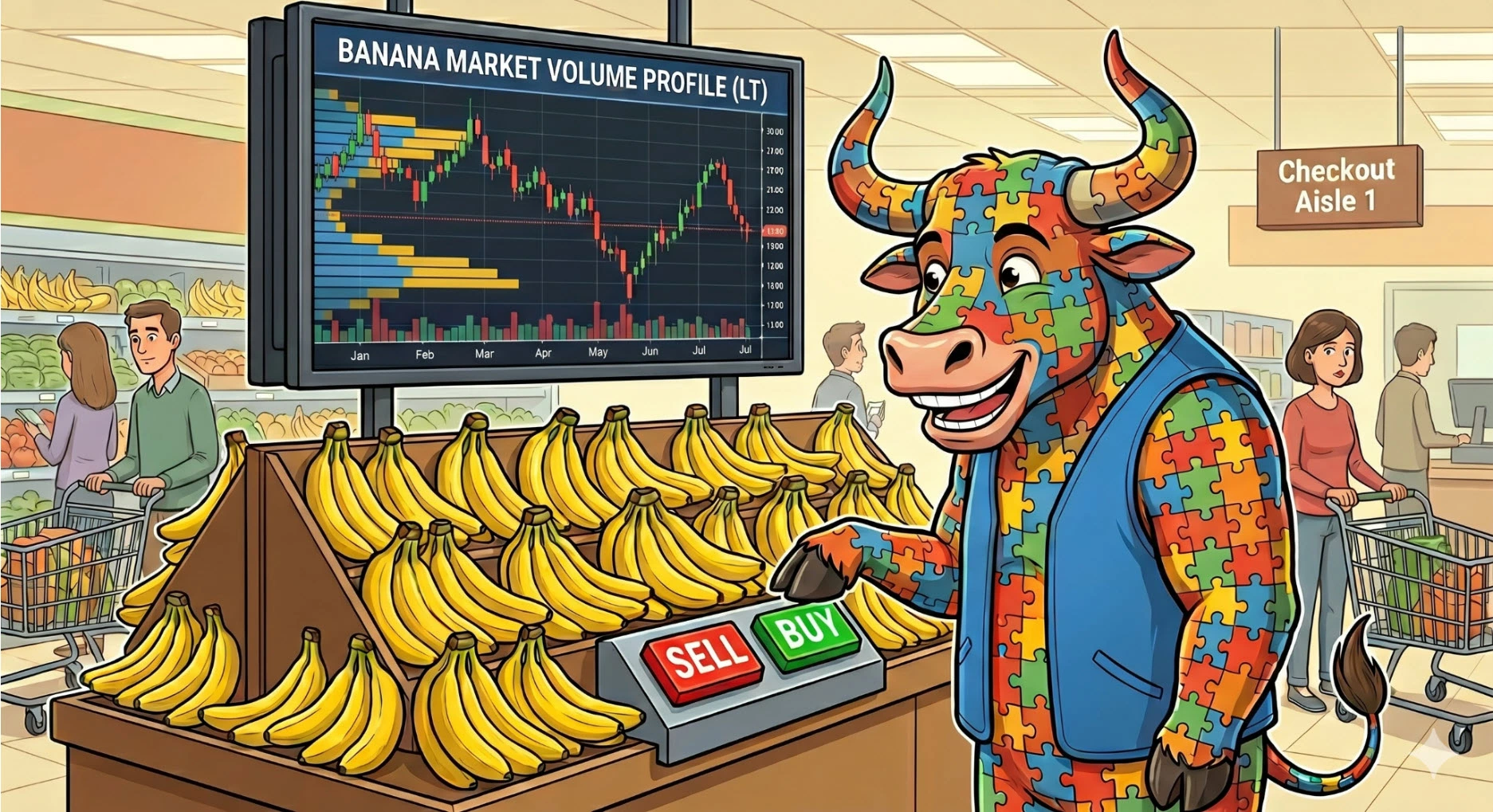
No, but it would be a great way to get men to do the weekly shopping.
So where is the value in Volume at Price (aka Volume Profiles)?
Make Better Sense of the Market. Every Morning. In Minutes.
Discover how to have each trading day mapped out for the markets YOU trade. Price moves, news, correlations, risk, futures & options positioning, GEX, geopolitical events and key price levels. Gathered by us, rated for sentiment and impact, then delivered in plain English. Interpretation, not just information.
To me, the value is in knowing where people are likely to be positioned. But first, the elephant in the room:
Not every trade is directional. Not every trade is short term.
By directional, I mean buy to sell higher or sell to buy lower. Benefitting from a move. If you trade Crude, you might not notice that something like 30% of trades on your market are one half of a “spread” trade. A trade that has 2 or more positions (called legs). In a calendar spread, you might buy December Oil and Sell March Oil. The trade will be profitable if the prices get closer together. So the price move in any one leg of the move is irrelevant. It will still appear as volume on your profile. You just cannot assume that price moving far from their entry point will trigger them to exit their positions.
Also, many trades are not short term. It might be a market maker adjusting a hedge, it might be someone in the oil supply chain locking in prices. These traders also will not react to short term moves.
You still didn’t tell us.
Regardless of the above two points, you CAN still consider EVERY trade to be a day trade if you are daytrading short term reactions (that can become long term ones). My rationale for this is:
- In any area of high volume, there will be a mix of short and long term traders.
- The long term traders will NOT react to short term moves
- The short term traders will react to short term moves
- Therefore: the short term trader’s reactions are still the ones that set the tone for the day
I gave myself a pat on the back for coming to that realization a long time ago.
In the 2010s, Long Term Volume Profiles had become a religion “it’s just the way the market works”. If that’s enough for you to trade off, great but I need a solid rationale of why people would react at that point. Also, I test things out and either my tests were wrong or these areas didn’t cause reactions way more often than they did. For me and the VP, that involves distance.
Distance is King.
Let’s say there’s a lot of volume traded at 6500 in the S&P e-Mini Futures, then the price moves up to 6800. A 300 point move from an area of volume.
We already decided we don’t care about spreaders and hedgers, we consider everyone a daytrader. So if we go back down 300 points:
- Will longs from that area still be in the market? That means they sat through a 300 point move up, then watched as it fell 300 points back down to their entry price – and they are still in. Well, I’d propose not many traders would survive with that approach.
- Will shorts from that area still be in the market? That means they sat through a 300 point move against them and then, it’s back to break even and their reaction would be to exit with a “phew”. Not many traders would survive that either.
The closer an area of high volume is, the more likely it is you will get a reaction.
And just like the end of an episode of Flash Gordon, we’ll leave you on a cliffhanger and leave it for lesson 19, where we dive into short term volume profile reactions.