
Trading Rule #15 – Come for Volatility Before it Comes For You – Adapting – Part 2
I’m happy to say that this is the Grinchiest post of the entire series. It’s all uphill from here.
In article 14, I mentioned moving from stocks because it was a moving target. Well, here’s part 2, where we acknowledge that everything is a moving target.
And talking about hills…
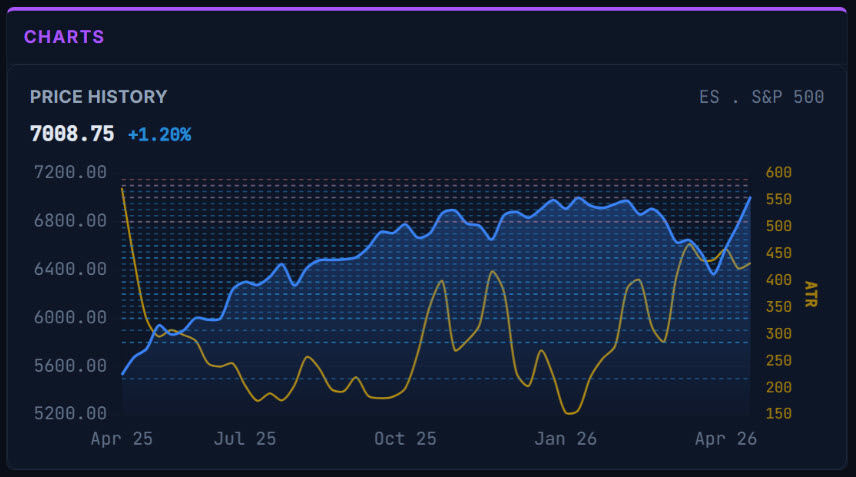
S&P500 Futures – blue line is price, brown is ATR (average daily range) – Jigsaw MI Pro
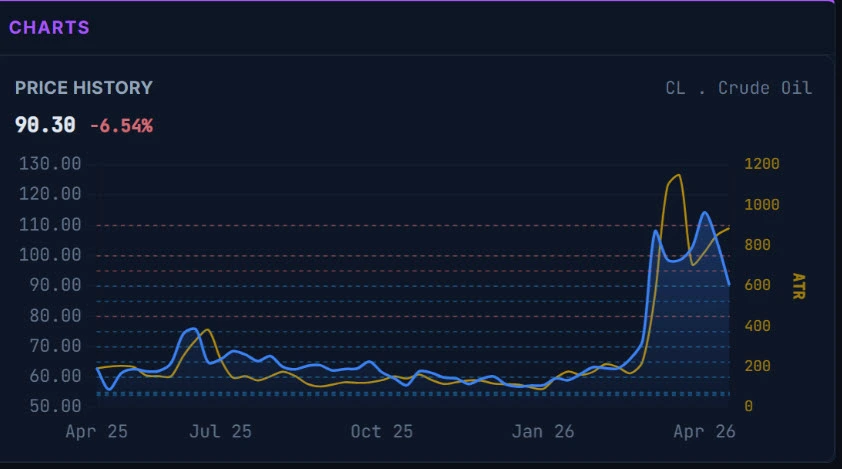
Crude Futures – blue line is price, brown is ATR (average daily range).
Today is April 15th, 2026 and Trump has just ‘blockaded’ Iran’s blockade of the Hormuz Strait. Crude ATR is now 887 ticks a day and ES is 433 ticks. When I started on ES – 80 ticks was a good day.
The ES chart is quite interesting; look how many times volatility has shifted in the past 12 months.
Those shifts mean:
- Some trades will stop working.
- Some trades will need wider stops and smaller size.
- New opportunities will be available. (usually based on the reason for the additional volatility).
Higher volatility means more risk and more opportunity. Lower volatility means less opportunity. Both can cut your account to shreds.
How you respond might be impacted by what type of account you are trading. For those of you forced into consistency rules, you will not be able to “make hay while the sun shines” like someone trading their own account, so wider stops and smaller size for you or your online prop firm might kick you off for having a big day. On the other hand, for those with your own accounts, you might consider going in small and then scaling in as it goes your way because that could be 3-400 ticks for 100 ticks risk. Sure, you might need a very wide stop, but you size up as it moves your way.
The way I like to think about it is playing Frogger (https://happyhopper.org/) or space invaders. The further you go through the game, the faster it gets – BUT – you can see it getting faster.

You can see it speed up, maybe not the first time you play as you’ll be -3 lives before you get that far.
Make Better Sense of the Market. Every Morning. In Minutes.
Discover how to have each trading day mapped out for the markets YOU trade. Price moves, news, correlations, risk, futures & options positioning, GEX, geopolitical events and key price levels. Gathered by us, rated for sentiment and impact, then delivered in plain English. Interpretation, not just information.
Over time, you should be able to observe a familiar market and say “that’s fast today”. But only if you remain mindful of it.
This is one of the reasons we advocate Order Flow – it’s way easier to see acceleration on the DOM/Tape than a chart. And we have various ways to slow down ultra-erratic markets like NQ with features like tick compression that shows fewer prices in return for readability. It tames the tiger.
Volatility will change when:
- The RTH session starts (regular trading hours in Futures)
- News comes out
- During lunchtime
- At times of high geopolitical risk
And this is the grinchy bit. Your success as a trader is dependent on you being able to recognize the market is faster or slower right now. A “setup” is not a setup unless it has rules for adjusting for volatility, including parking it when volatility doesn’t match.
Most people at this point will ask “Which indicator do I use to tell me if the market is faster”. I highly recommend this one:

If you can watch something every day, day in-day out and NOT recognize it’s a bit faster today then DO NOT TRY CROSSING THE ROAD.
This is an innate skill humans have for hunting and survival. It’s built through observation and practice. Repetition.
So don’t look for an indicator, by all means look at the ATR from the past week or so as reference but if you try to lean on an indicator, you won’t build the raw skills that made you the hunter/gatherer you really are.
I think there’s a fear with topics like this because I’m effectively saying “use what your creator gave you and rely on it” (no, not your mom) but most traders want tools to replace skills or learning. They yearn for the mechanical because it absolves them of making a decision. But take them back 10,000 years with an empty belly, a spear and a field of yummy zebras and they wouldn’t ask you for a Zebra indicator. They’d miss a few Zebras at first but eventually become the killing machine on the plains that they need to be in the markets.
And seriously – we really do want you to eat your fill.
The lesson: If you ignore volatility – it won’t ignore you.