
Trading Rule #11 – Discretionary Trading
A lot of people split trading into 2 categories – mechanical “rules based” trading and discretionary trading.
The implication there is that discretionary trading is trading without rules. We’ll blow away that myth later.
First, I will state one thing clearly – Mechanical Trading is a myth. It does not exist. Even algorithmic traders have to know which systems to switch on for current market conditions. Now, I am referring to outright trading, spreading is different.
Most people think “it’s all in the charts”, because books that are now 70 years old say so, and it’s an easy thing to learn and sell. Discretionary trading is more holistic, which is why we talk about “exploiting events” than “trading setups”.
FREE BONUS: Take a look into the decision-making process of professional traders with this video training series that helps you make smarter trading decisions. (Article continues below)
Perhaps the funniest recent example of a blinkered trade, that has no interest in anything outside of charts was this…
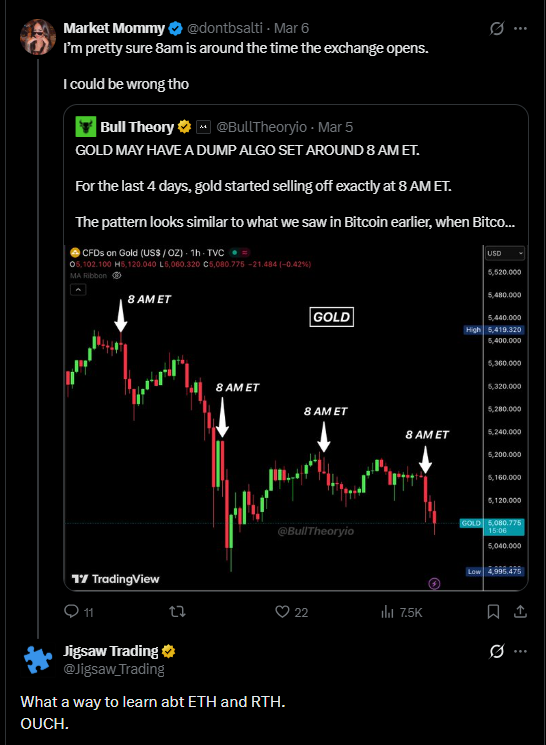
This isn’t a trader – it’s someone selling education. And blissfully unaware that on his (5-hour?) Gold chart, there’s a sudden burst around 8:20 am, the traditional ‘market open’. These opens aren’t hard opens anymore, but people have to start some time right – so Crude, Gold, S&P Futures of course see an increase in volume at those times.
So this is not a holistic trader, it’s someone that won’t peek past his chart.
These are the guys that say “the algos took me out of my 1 lot short oil trade”, without even considering that bombs are dropping all over the Middle East.
This doesn’t mean all discretionary traders are better.
Many are playing whack-a-mole with the market where FOMO is the main entry criteria and YOLO is what they tell themselves after losing $15k in a 12 hour Red Bull fueled trading session.
Discretionary trading is NOT watching a chart and taking punts.
It is rules based and the best way to explain it is with some examples.
- I’ll start at 8am, check the news that impacts my markets, and decide which to focus on.
- Unless I have a specific opening play, I’ll let the markets settle down
- I’ll have some price levels to look at – obvious long-term turning points, overnight high/low – but I won’t trade them.
- I’ll see if there is a reaction around the level, a larger, faster move with high volume away from the level
- Then I’ll look for a weak pullback and try to get in at a good price, with Order Flow on my side
- I’ll give the trade plenty of room to let it play out, in the early stages, I’ll be looking for my trade failing and then I’ll let it play out, scaling out as I go.
- I’ll use bigger stops on more volatile days with smaller size.
- I’ll be careful around major areas and keep an eye on the risk calendar so I’m not entering when the market could change characteristics
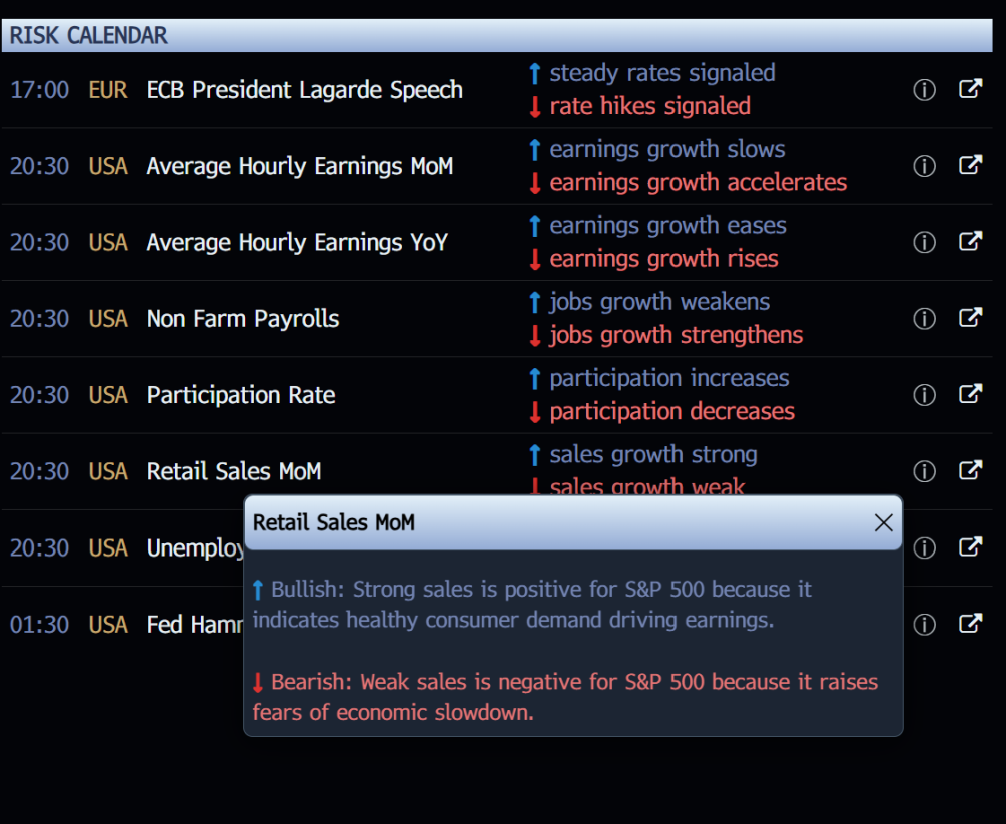
Obviously, each of those rules can have a paragraph with more information, but you get the idea. These rules are strict, but they are not mechanical and if you ignore one – it’s your fault.
The difference is stark. Mechanical traders add layers and layer of rules, but it never works and more rules makes it harder to stick with it. But a mechanical system for a “Middle East Crisis” day – sure, another for “Slow Summer Days” – absolutely. But you still need the discretion to know when to turn it on and off.
If you are interested in a deeper dive into discretionary trading rules, here’s a great video for you:
In it we discuss topics such as:
- Rules with flexibility AND guardrails.
- Getting away from “Shooting From The Hip”.
- Using the news environment to predict volatility and select setups for today.
- Fine-tuning pullback plays.
- Leveraging your subconscious, like a tennis pro.
- Skills development through experience, repetition and feedback loops.
- Letting your subconscious do its thing.
And more.
Discretionary trading is all about common-sense rules, it just feels scary relative to mechanical rulesets. But only because of the illusion that mechanical rules mean you don’t have to make decisions in the heat of the moment.
This is a much shorter path than trying to find a mythical combination of indicator settings, and it’s way more fun.
I know a guy that retired at 35 after writing barrier options for RBS. I once asked his view on technical analysis, and I gave him a list of common indicators. His reply was golden.
“I have no idea what any of that stuff is”.
Glad I met him.
FREE BONUS: Take a look into the decision-making process of professional traders with this video training series that helps you make smarter trading decisions.



0 Comments