
Trading Rule #12 – We Need To Talk About Trade Exit Strategy
Let me start off by saying this:
“It is impossible to have a perfect trade exit strategy.”
Not difficult. Impossible.
FREE BONUS: Take a look into the decision-making process of professional traders with this video training series that helps you make smarter trading decisions.
To recap what we’ve discussed already in this series – you need to trade events, and an event can be anything from the weather (corn, wheat), geopolitical events (war in Iran), economic announcements (employment numbers), general breaking news, and of course, technical patterns/order flow. You can, of course, trade combinations of events.
An event is a little like throwing a rock in a pond.

The event causes a ripple effect – like a rock in the water, but the ripples don’t go on forever. If you sell the top of the range, the market doesn’t go all the way down to zero. So an event has an impact, which in itself will be impacted by how volatile the day is.
We call this “Signal Scope” – or “how far does this event usually move the market.”
So, it should be easy to look at a lot of events and see how far the market moves on average, right?
Wrong.
The reason it’s not measurable is that when that signal has played out, the market will then do 1 of 2 things:
- Go up
- Go down
So let’s say the signal can move a market 10 points, it can do that, and then the market could move another 10 points for completely different reasons. Just because your event causes a reaction, it doesn’t cause a counter-reaction.
You could argue that the event ends when people take profits. That’s possible, but the bottom line, the reality is that it is very difficult to know when your event has stopped moving the market and now the market is just going one way or another.
And if you do statistical analysis, it will be skewed by the fact that 50% of the time it’ll carry on going your way once the event is over. Also, backtesting stats probably won’t tell you when another event overrode your event.
It’s not as if signal scope doesn’t exist. It’s just hard to backtest it, because “end of event move” does not mean reversal.
So now your trade is a bit like riding a banana boat. You know when you are getting on but not when you are getting off.

So what to do?
Fixed targets, scaling in, scaling out and ATR-based stops all have merits, but there is no way to mathematically prove one superior to the other.
For range trades or fake breakouts, it’s a little easier. You want to get to the other side of the range. If it fails to get through the prices with the most volume in that range, watch out.
For directional/trend trades, ATR based stops are interesting. ATR is a measure of volatility and so it increases with volatility. Just one thing: volatility switches at the open of the RTH session, so at 9:30am NY on US Index futures, ATR will be of no use. 30 minutes later, no problem. Even if you scale in/scale out or “all in all out”, you still have to deal with daily shifts in volatility.
For me personally, I prefer a systematic approach with wiggle room on trend trades:
- Get in with a stop and have many scale out points.
- Stop and scale outs are set by volatility.
- If you hit your first scale out, set stop to break even.
- If it fails to fill at first scale out – let it stop you out at break-even.
- The reason – if your event is solid – you should get a pop. No pop – let it stop you out.
- If you do get a fill on target 1, move your stop back down.
This puts much risk at the front end, so my focus is on watching for a ‘pop’ or a reaction early on and then either cutting or letting it run. If it runs real fast, I’ll move my targets further away.
This might sound odd, like the rules should be more mathematical. But it’s really all about practice and trying not to get in the way of the trade. It’s my comfort zone.
You can scale in, you can scale out, you can go all in and all out (the hardest in my opinion) but…
Whatever you do, once you get out, the market will do 1 of 2 things:
- Go up
- Go down
That means that once you exit your trade, it is likely to carry on in your direction 50% of the time, and that can make you think, “I left too much on the table.” This can become a psychological trap. Watching a market carry on without you can make you feel worse than a losing trade. Trying to “fix” the unfixable can cause you a lot of stress and wasted time.
The message here is that there is no perfect way to backtest the best trade exit strategy.
In terms of tools to help with exit, I use as little as possible.
Here you see the Jigsaw Depth & Sales with a strength meter next to it.
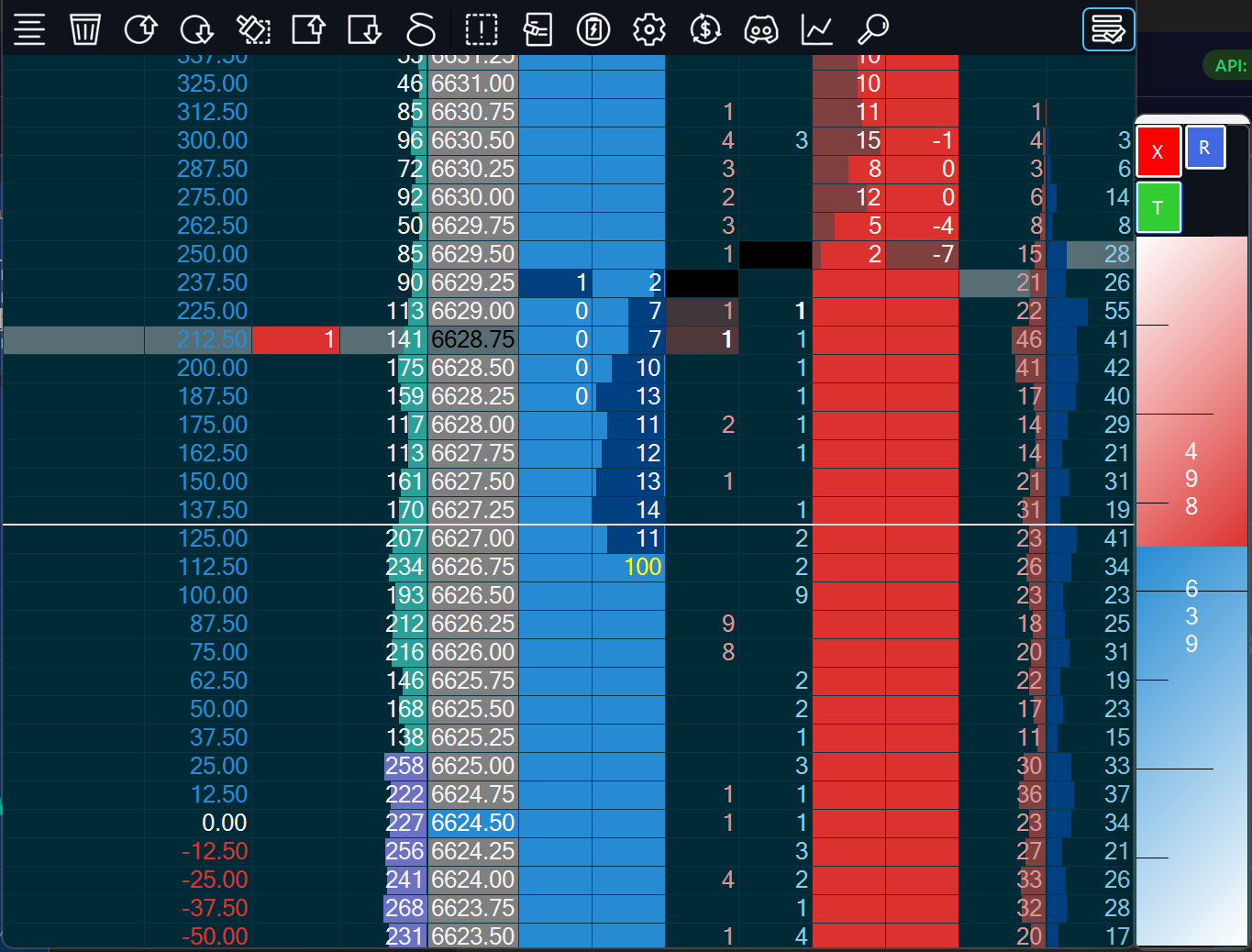
The Depth and Sales is the best way to read order flow.
It’s like learning to cross the road, assessing the speed of the cars coming towards you. First dad holds your hand and eventually you do it alone. Our version of hand-holding is giving you order flow doing drills, which open up another dimension of the market to you.
To the right is the trusty “strength meter” which shows the number of sell market orders (red) and buy market orders (blue).
Let’s say you go long and people join in, you should be seeing 2x more buy market orders than sells.
In this case, we do have more buyers – but it’s not significant. This is not a high confidence trade. There is no real imbalance.
As a supplement, I like to know what the swingers are doing…
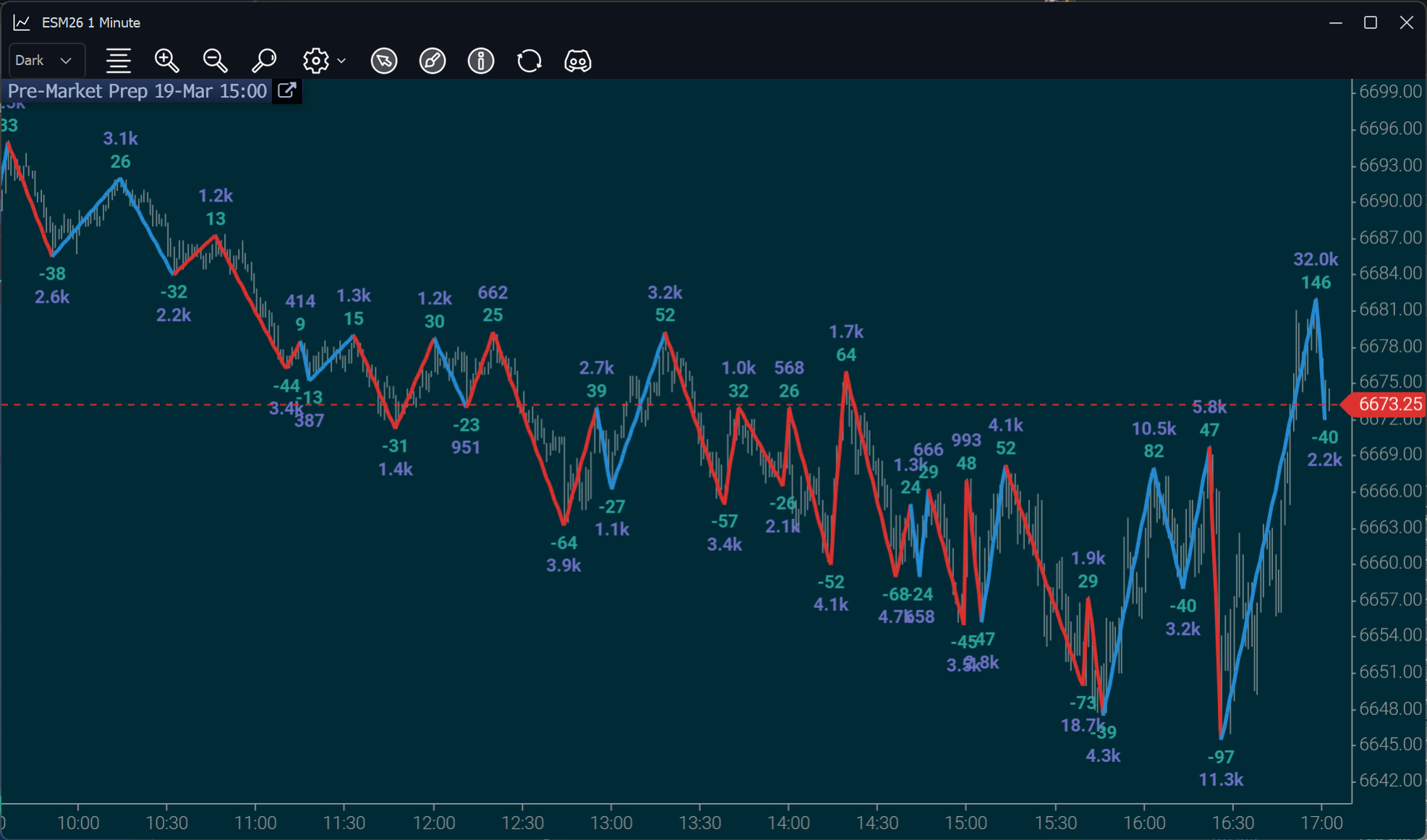
I don’t worry about bars, just moves. How many contracts in a swing? How many ticks?
In this case, we see a big swing up of 146 ticks and 32k contracts, so it looks like we’ve reversed up. I like things to stay blue if I’m long.
Mostly, I’m just trying to get far enough from my stop to relax and let it run. If I’m lucky, I run out of targets. If the market carries on – who cares?
The key for a good trade exit strategy is to have some consistent rules, even if they have wiggle room like mine. At the start of your trade, look for a pop, a little bounce your way, a little confirmation that yes, your event is causing a reaction. Once you have some room, let it play out.
If you research this, most points to the more you manage, the worse the outcome. You can’t fret over every pullback. I have also looked extensively and I expected some math whizz must have come up with a mathematically superior approach. If they have, I couldn’t find it.
Do your thing and do it well. Keep it simple and repeatable. The best approach is the one that gives you the most comfort.
After that, just put in the reps and you will get better and better at squeezing more out of the opportunity the day presents. However you manage your trades now, you will get better at it.
But the eternal search for the perfect approach?
I really don’t want to go down that rabbit hole again…
There isn’t one.
FREE BONUS: Take a look into the decision-making process of professional traders with this video training series that helps you make smarter trading decisions.



0 Comments