
Trading Rule #19 – Sensible Use of Short Term Volume Profiles
In Trading Rule #18, we discussed the use of Volume Profiles, the type you see on the chart. Today we’ll be talking about the current day’s volume profile.
I made it clear in lesson 18 that it was a bit “flaky” to say “long term volume profile works because the market has memory”. I stand by that. On the other hand, short term volume profiles work because of where people are likely to be positioned.
Free Training
Take a look into the decision making process of professional traders with this video training series that helps you make smarter trading decisions.
For those that don’t know it – the volume profile is the colorful column. The colors indicate the value areas, point of control, VWAP etc. The numbers represent the total number of contracts traded at that price.
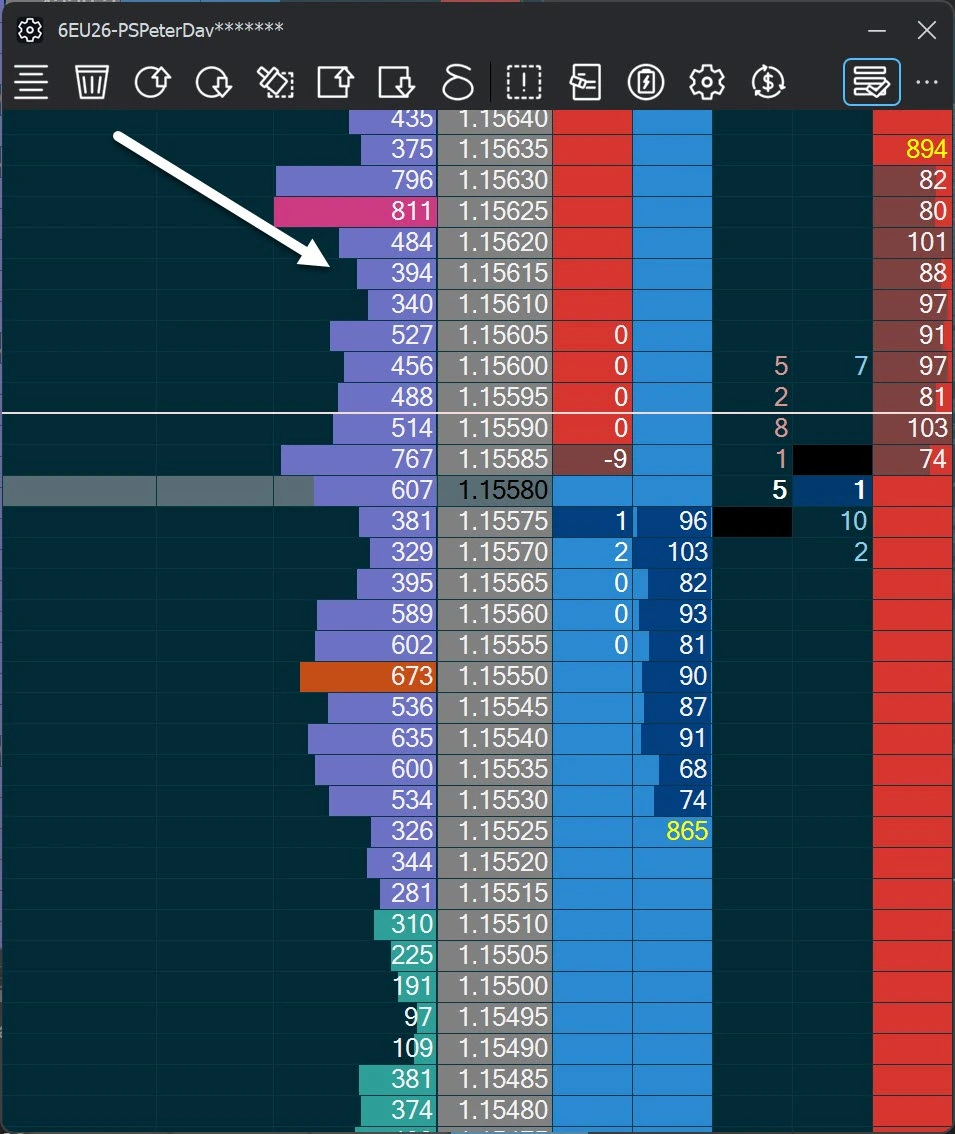
Before we dive into using it, we have to address the elephant in the room, then shake hands with it and thank it for the memories.
That volume does not just represent people trading outright positions (directional trading buy to sell higher or short to buy lower).
Crude is an extreme example of this. The front month in Crude is approximately 50% of trade and spreads (e.g. buy August Oil, Sell September oil) account for 50% of all trading. If you go past the front month, it’s more like 30% outrights.
From the outright traders, approximately 60-80% close their position on the same day and 20-40% are longer term traders.
This is different for each market. The reason this is important is:
- Spread Traders do not care what happens on one side of the trade, they care about the relationship between the different expiries/instruments. Hence, there is no expectation that these participants will react to a move against them.
- Long term traders are also likely not that bothered about regular intraday moves.
So, on WTI Crude, it is safe to say that much of the volume is irrelevant to the intraday trader.
And this does not matter at all.
Why? Well, let’s say at each price, we have 50% people that won’t react to intraday moves and 50% will. That will not change the SHAPE of the profile. So if you have more volume at a price, you can assume that there’s enough short term trades there to cause a reaction when they get caught offside.
High volume nodes represent areas where a lot of short term traders are positioned. The best analogy I can think of is Candy Floss (or cotton candy to my American friends).

High volume nodes normally start with high volume at a single price. Then it’ll trade above that price, then below it, then above it. Each time it goes a little higher and lower – building visible high volume. Just like cotton candy builds up around the stick. You can watch it play out in real time, just watch and you’ll see that high volume and then the market keeps crossing above and below it.
What you end up with is this:
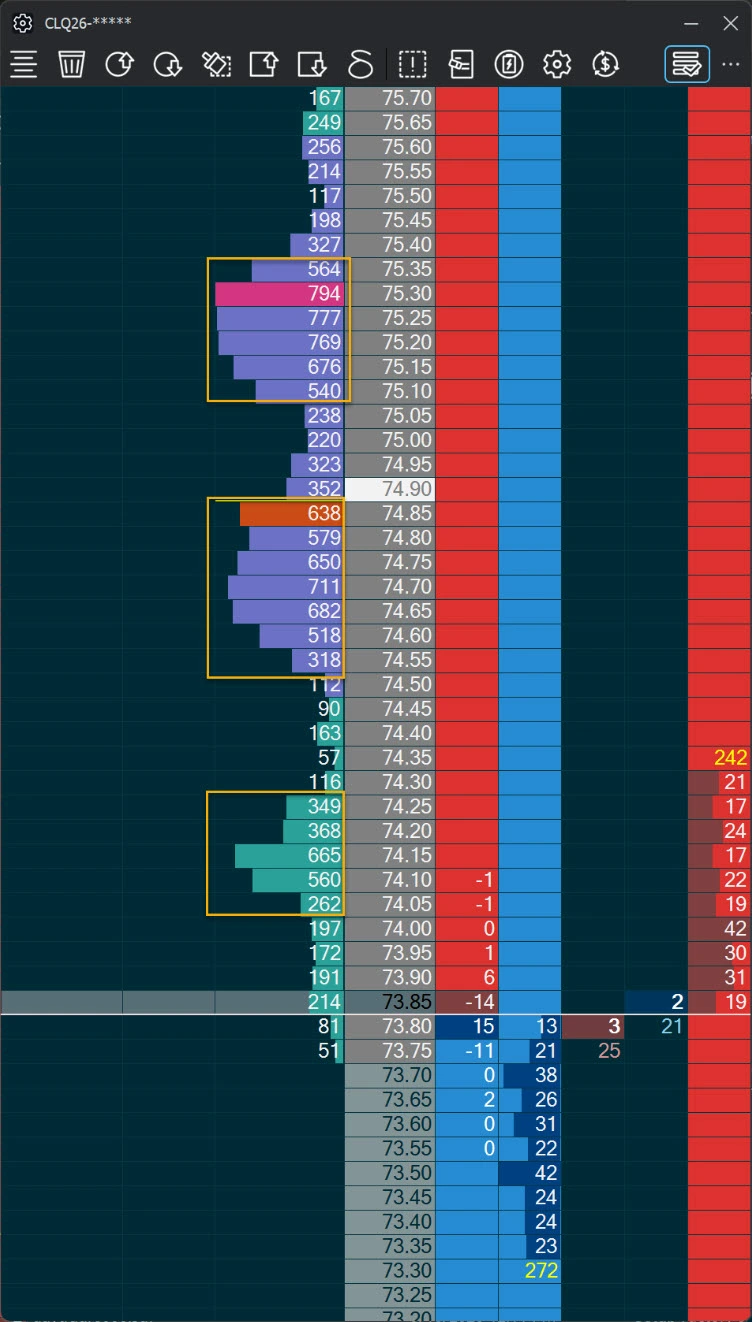
The yellow boxes are high volume nodes. There are people long AND short in those areas and one side is going to lose.
So how do we take advantage of the short term volume profile? There’s a few ways to play those high volume nodes.
- Buy the bottom and sell the top. Sometimes the high volume will turn into a trading range that lasts quite a long time and grows to a decent height. It’s a good trade but the more time it hits the end of the range the less likely it is to hold.
- The headfake. The range breaks – but it’s just some BSD nudging the market against one side and the move quickly fades and back you go into the range. Expect a headfake after 3-4 hits of the range extremes, use the order flow to watch the headfakers exit. If you are targeting the opposite end of the range, then the headfake by its nature has more reward potential.
- The retest. The market breaks properly, you can see it in the flow. Let’s say the market has a range with 10,000 contracts and we break upside. That’s thousands of shorts nursing their wounds, they’ve just taken a hit shorting there – will they really short again? Nope, which is why, after a break upside, we come down and sellers disappear. So the trade is to go long on a retest of the top of the range. Shorts that are still in are going to take the opportunity to bail out as it’s not going their way. Longs may take the opportunity to add more at better prices. It’s an imbalance.
We can see that in the above image the high volume node low is 74.05. Very likely we still have some longs holding on and if we go back up to 74.05 it could be rejected because of the positions there.
But let’s say we trade down to $65, hundreds of ticks lower
- Will the longs from that high volume area still be there, having sat through a massive loss, or will they have cut their losses and exited earlier?
- Will the shorts from that high volume area still be there, having sat through a massive win, or will they have taken profits?
I think you can answer both questions yourself.
Fact is, when you move far from the high volume node, it is unrealistic to think that people will react, not the daytraders, the long termers or the spreaders.
Short-term volume profile is useful when it shows recent positioning. It becomes less useful when price has moved far enough that those traders are probably gone.
To summarize rule 19: Use short-term volume profiles as a map of recent positioning, not as permanent support and resistance. Once the traders behind the node are gone, the level loses its edge.